(Sponsored Content) — U.S. Battery is celebrating its 100th anniversary, and throughout its history, it has made numerous developments in battery technology that have enabled battery-powered lifts and cranes to run longer and more reliably, with lower annual operating costs.
Many improvements in battery technologies, including Flooded Lead Acid, AGM, and Lithium-ion, have helped U.S. Battery meet and stay ahead of the changing demands of the lift and access industry, while always looking ahead to what's next.
FLOODED LEAD-ACID BATTERY INNOVATIONS
U.S. Battery has, throughout its history, developed significant advancements to deliver longer cycle life, increased capacity, and faster cycle-up to full-rated capacity than previous FLA designs.
Lead Grid Plates
U.S. Battery found that the limits of the FLA cell design were the corrosion that occurred in the battery’s positive grid plate. The use of Selenium as an additive was introduced into lead antimony to refine the lead grains into a fine alloy. This provided greater strength and corrosion resistance than conventional lead-antimony alloys, and positive-grid corrosion is no longer the primary failure mode, thereby improving cycle life for FLA deep-cycle batteries.
Lead Sulfate Crystals
Historically, positive electrodes have been processed using a procedure called hydroset, which is designed to ‘grow’ tetrabasic lead sulfate (TTBLS) crystals on the plates. U.S. battery found ways to improve the active materials on the positive plates from using a mixture of lead oxide, sulfuric acid, and various additives to increase the life of the positive electrodes.
By using proprietary crystal-seeding additives, U.S. Battery discovered that the crystal size range can be controlled to the most desirable levels. Uniformly controlling crystal size in the TTBLS structure resulted in increased initial capacity, faster cycle-up to rated capacity, higher peak capacity, and improved charging across a wide range of charger technologies used in various applications.
Active Materials
Further improvements have resulted from adding active materials, such as carbon additives, to the negative plates of deep-cycle batteries. Carbon additives prevent the natural tendency of the negative active material to shrink or coalesce during cycling, thereby reducing capacity and life. Recent improvements in these carbon materials have opened new opportunities to address several performance limitations of lead-acid batteries.
ABSORBED GLASS MAT BATTERY INNOVATIONS
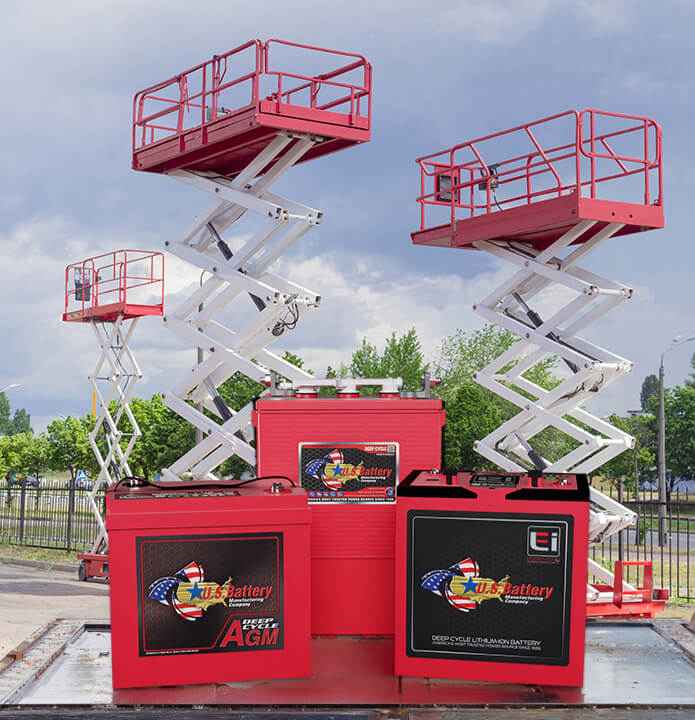
Absorbed Glass Mat (AGM) batteries are very similar to flooded lead-acid batteries, with the key difference being a sealed construction in which the electrolyte is contained within glass mats that surround the battery’s electrodes. U.S. Battery has also continued to advance its AGM batteries by improving positive electrode corrosion resistance and adding carbon-enhanced negative active materials to enhance charge acceptance. AGM batteries cost more than FLA batteries, but they are an excellent option for applications with difficult-to-access battery compartments or where corrosion is a concern.
LITHIUM ION BATTERY INNOVATIONS
Lithium-ion batteries are the newest type of battery in U.S. Battery's product line. In 2022, the company introduced its Essential Li® line of deep-cycle batteries, with a commitment to delivering high quality and reliability.
For this line of batteries, U.S. Battery chose Prismatic LFP cells instead of Cylindrical cells used in most Li deep-cycle batteries. While the rest of the industry used spot-welding to connect the battery cells, U.S. Battery preferred laser welding to provide greater shock and vibration resistance.
Most recently, U.S. Battery also took the step to have its line of 24V and 48V Li batteries tested by the Underwriter’s Laboratory to receive UL 2271 certification for preventing fire or explosion, UL 2580 certification for quality and safety when used in electric vehicles, and UL 38.3 certification for safe transport in the U.S. and globally. U.S. Battery's Essential Li® line of Li batteries is also IP67-rated for dust and moisture resistance.
In 2025, U.S. Battery also began integrating a heating element into its Essential Li line of batteries to improve charging efficiency in colder climates and during seasonal use.
CONTINUING THE COMMITMENT
While battery technology continues to expand and evolve, U.S. Battery will continue to innovate and improve its designs to deliver greater efficiency, reliability, and the highest-quality products. For more information on deep-cycle batteries for electric cranes, access lifts, and more, visit www.usbattery.com.
Jun 10, 2026

Lift & Access is part of the Catalyst Communications Network publication family.