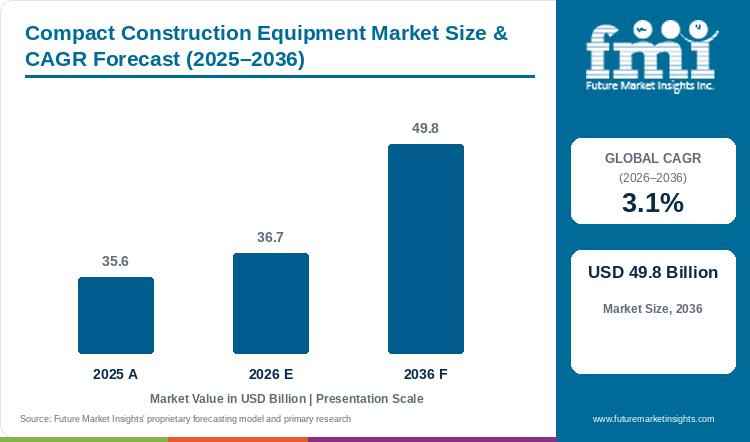
The global compact construction equipment market is estimated to reach $36.7 billion in 2026 and is projected to grow to $49.8 billion by 2036, according to Future Market Insights (FMI). The forecast represents a compound annual growth rate (CAGR) of 3.1% from 2026 to 2036. The market was valued at $35.6 billion in 2025.
FMI's Compact Construction Equipment Market report examines demand for compact machinery across urban construction, utility projects, landscaping, infrastructure maintenance, and other applications where operating space may be limited.
The report identifies compact excavators, skid steer loaders, compact track loaders, and other small-format machines as equipment used to address restricted access and varied job-site requirements. It also examines how machine capabilities, attachment compatibility, transport requirements, and utilization influence equipment purchasing decisions.
Attachment versatility is one factor shaping the compact construction equipment market. Buckets, augers, breakers, trenchers, and other tools can allow machines to perform different tasks across construction and maintenance applications.
The report also identifies hydraulic performance and working capacity as important equipment considerations. Productivity depends on factors beyond engine horsepower, including attachment performance, lifting stability, traction, reach, visibility, and operating clearance.
Other equipment developments discussed in the report include self-levelling platforms, telescopic booms, articulating arms, dual-fuel engines, and regenerative braking systems. These technologies can influence equipment performance, fuel efficiency, and utilization.
Compact equipment applications identified in the report include utility trenching, material loading, urban construction, landscaping, property maintenance, and localized road and infrastructure repairs.
Equipment rental is another focus of the market analysis. Rental companies provide access to compact machinery without requiring customers to purchase equipment. Their fleet decisions involve balancing customer requirements with transportation costs, maintenance, equipment availability, and idle time.
Rental models also allow contractors to adjust equipment access according to project schedules and changing workloads. For direct equipment owners, purchasing decisions involve evaluating expected utilization against acquisition and ongoing operating costs.
The report identifies total cost of ownership as an important consideration. In addition to purchase price, buyers evaluate fuel consumption, maintenance, transportation, utilization, and expected service life. Equipment that can serve multiple applications may offer greater value when supported by compatible attachments and reliable service.
FMI projects the global compact construction equipment market will grow from $36.7 billion in 2026 to $49.8 billion in 2036. The report identifies construction activity, utility infrastructure development, landscaping, and maintenance work as factors supporting market demand.
Companies operating in the compact and broader construction equipment industry include Caterpillar Inc., Bobcat Company, Deere & Company, Kubota Corporation, JCB, Takeuchi Manufacturing, Yanmar Holdings, Wacker Neuson, Komatsu Ltd., and Volvo Construction Equipment. FMI notes that the companies listed are industry participants, not a ranking of market share in the compact construction equipment market.
The 250-page Compact Construction Equipment Market report covers market size, growth forecasts, industry trends, and competitive developments for the 2026 to 2036 period.
Nov 18, 2026

Lift & Access is part of the Catalyst Communications Network publication family.