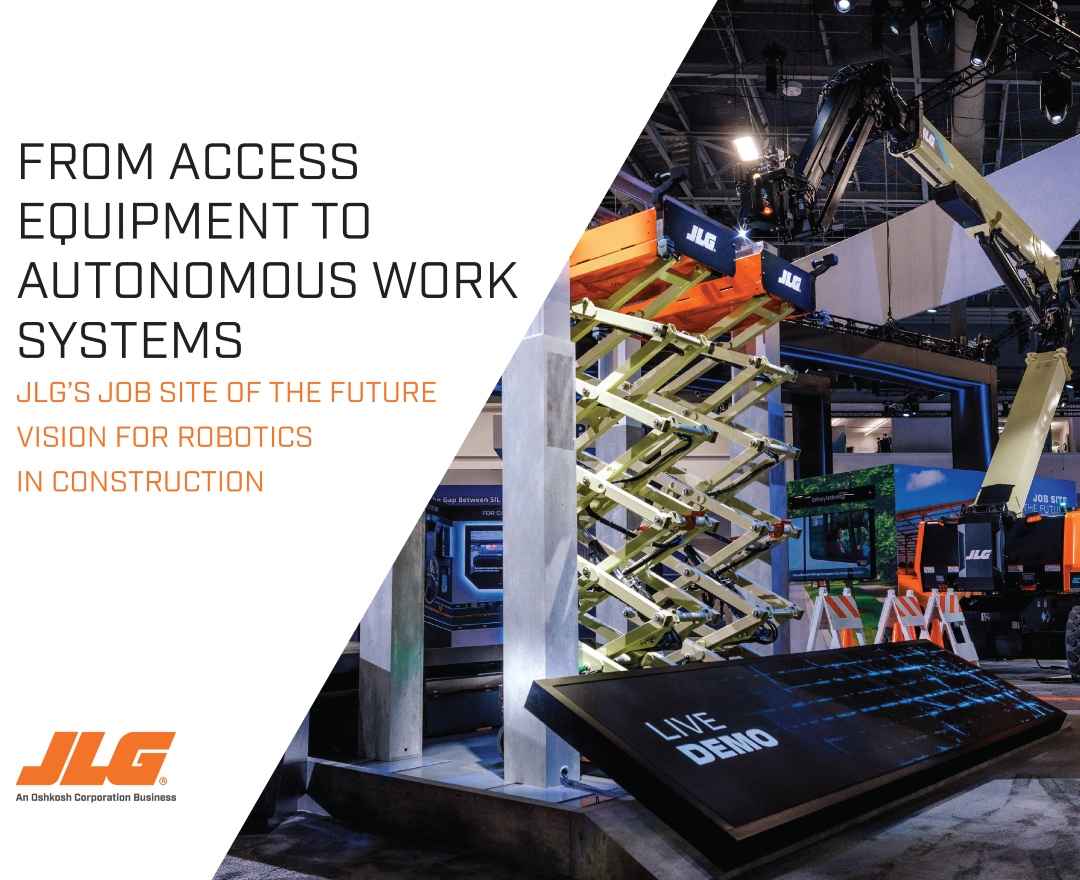
JLG Industries has released a new whitepaper examining how mobile elevating work platforms and other equipment are expected to evolve as construction job sites become more connected and automated.
The paper, "From Access Equipment to Autonomous Work Systems", outlines how advancements in robotics, connectivity and cloud-based technologies are expanding the role of access equipment beyond lifting applications. The report describes a shift toward systems that actively contribute to job site tasks through coordination and data-driven operation.
“Access equipment has traditionally enabled work at height,” says Shashank Bhatia, chief technology officer and global vice president of engineering at JLG, in the new JLG whitepaper. “Today, we’re redefining that role. By integrating robotics and connectivity, we’re creating intelligent systems that not only support work but help perform it.”
The whitepaper highlights the progression from standalone machines to integrated job site ecosystems, where equipment can communicate and operate as part of a coordinated workflow. It also reviews applications of robotic systems in areas such as drywall finishing and automation for elevated work.
According to the report, automation is being positioned as a tool to support the workforce by improving safety and reducing physically demanding tasks while helping address labor shortages and increasing project complexity.
“As job sites become more complex, the need for smart, connected equipment continues to grow,” Bhatia says in the whitepaper. “JLG’s vision provides a look at how those technologies can come together to deliver greater efficiency, consistency and visibility across the entire project.”
The whitepaper also reflects ongoing development in connected fleet technologies and machine coordination, as manufacturers explore new ways to integrate equipment into synchronized job site operations.
JLG, part of Oshkosh Corporation, has made the full whitepaper available through its DirectAccess platform.
Apr 23, 2026

Lift & Access is part of the Catalyst Communications Network publication family.