Utility construction presents unique challenges when establishing safe, reliable access to work areas. Unlike many commercial construction projects where operations remain within a defined footprint, utility work often extends across miles of changing terrain. Crews may move from paved roads to agricultural fields, wetlands, wooded rights-of-way, or residential easements during a single project. Equipment requirements also vary by application, from routine distribution maintenance and transmission construction to emergency restoration following severe weather.
Because every project presents different conditions, selecting the right matting system requires evaluating equipment, ground conditions, traffic patterns, project duration, and site logistics together rather than relying on any single factor.
Application Matters
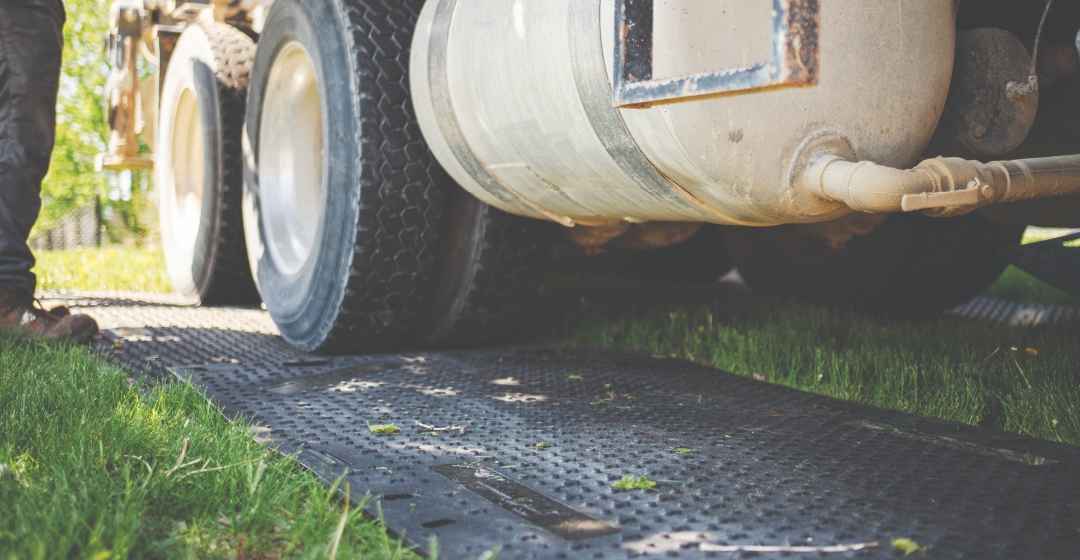
Distribution crews typically operate bucket trucks, service trucks, pickup trucks, and smaller digger derricks while performing maintenance, service upgrades, and emergency response. Work is often completed at multiple locations throughout the day, making portability and speed of deployment important considerations. Matting that can be transported easily and installed without dedicated lifting equipment allows crews to respond quickly when access conditions change unexpectedly.
Composite mats are commonly used in these applications because they provide sufficient support for wheeled utility equipment while remaining practical for frequent deployment.
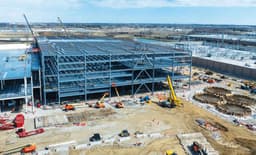
Transmission construction presents a different operating environment. Projects often extend across undeveloped rights-of-way where crews must establish access through soft soils, wetlands, agricultural land, or heavily wooded areas. Equipment may include cranes, large digger derricks, tracked excavators, bulldozers, drill rigs, and material handling equipment that remains on site for extended periods.
Under these conditions, matting may be used to establish temporary access roads, create stable work platforms, or provide access through environmentally sensitive areas. Multiple matting systems are often used on the same project.
For utilities, standardization should mean using a repeatable selection process, not prescribing one matting system for every phase, crew, or application. Foundation work, structure erection, conductor installation, and restoration activities may all involve different equipment, resulting in different matting requirements as construction progresses.
Beyond Equipment Weight
Equipment weight is one factor in selecting matting, but it should not be the only consideration.
Different equipment interacts with the ground differently. Wheeled vehicles apply loads through relatively small tire contact areas, while tracked equipment distributes weight across a much larger surface. Equipment movement, turning, braking, and repeated travel patterns also influence mat performance over the life of a project.
For example, mats that perform well beneath a bucket truck operating from a stationary location may not be appropriate for tracked equipment making repeated turns on saturated soil. Likewise, heavy timber mats capable of supporting large, tracked equipment may provide capacity well beyond what is necessary for routine distribution work, where portability and installation speed are often equally important considerations.
Rainfall, seasonal moisture changes, or repeated equipment traffic can alter soil conditions significantly. As site conditions change, the matting strategy may also need to change through larger work platforms, additional layers, or modified access routes.
Beyond Load Capacity
Selection must also account for how the matting will be transported, deployed, connected, maintained, and reused.
For routine distribution work, transportation and ease of installation may be one of the most important selection criteria. Mats that can be deployed quickly without additional equipment allow crews to respond efficiently to planned work as well as unexpected outages. On larger transmission projects, matting systems made up of larger and heavier mats are typically required as they provide greater durability for long-term construction activity.
Other performance characteristics also deserve consideration. Surface traction affects both vehicle mobility and worker footing during wet conditions. Connection systems help maintain alignment where repeated vehicle traffic is expected while reducing movement between adjacent mats. Durability, ease of cleaning, and resistance to moisture absorption may also influence long-term ownership costs for utilities managing large mat inventories.
Plan for Change
Selection is most effective when project managers, fleet and safety personnel, field supervisors, and equipment operators contribute their perspectives during planning. While matting decisions should begin during project planning, they should not end once equipment arrives on site.
Planning should also consider how matting will be delivered, installed, relocated, and ultimately removed from the project. Selecting a product that meets load requirements but creates unnecessary logistical challenges can affect productivity throughout the job. For connected matting systems, the access route, turns, work platforms, and installation direction should be planned before the first mats are unloaded. Transportation requirements, available installation equipment, storage capacity, and anticipated reuse all contribute to the overall effectiveness of a matting system.
Building flexibility into the project allows crews to adapt as field conditions change. That may require extending an access road, widening a work platform, reinforcing higher-traffic areas, or relocating matting as work progresses.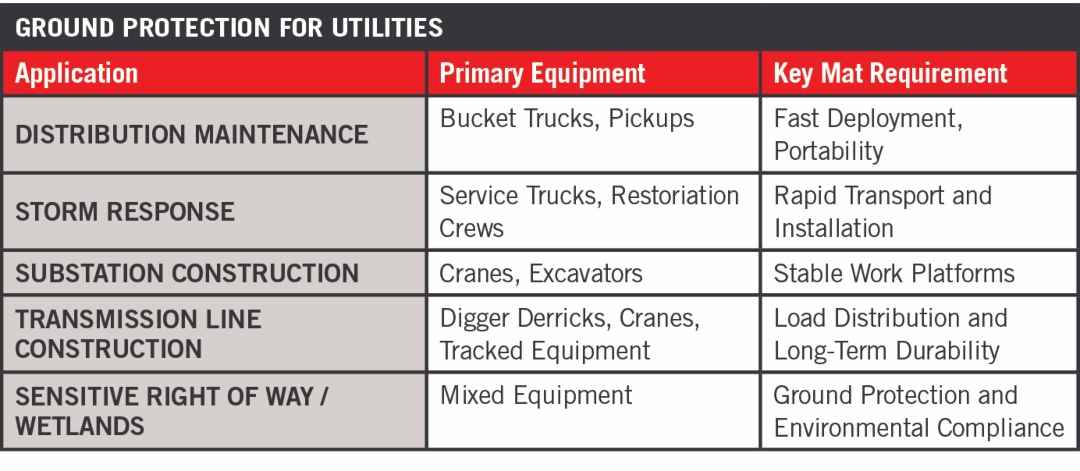
Fleet-Level Planning
For many utilities, matting is managed the same way as other fleet assets. The objective is to have the right type and quantity available where the work is taking place, without creating unnecessary transportation, handling, or downtime.
This is particularly important for utilities operating across large service territories. Light-duty mats may be stored at multiple yards or carried on trailers to support distribution crews, while larger inventories are staged for transmission projects and other planned work. Moving matting from one active project to support another is rarely efficient, making the location and availability of those assets part of the planning process.
The same strategy supports emergency response. Ahead of hurricanes, ice storms, wind events, and other severe weather, utilities can position matting in areas where access challenges are anticipated. When restoration begins, the priority shifts from optimizing a planned installation to giving crews the resources they need to make field decisions quickly and keep equipment moving.
Making the Match
Selecting matting for utility work is rarely a matter of choosing between timber or composite products. Distribution maintenance, transmission construction, storm response, and other utility applications place different demands on matting because the equipment, site conditions, duration of use, and deployment requirements are different.
The goal is not to identify one matting system that works everywhere, but to establish a repeatable process for evaluating the application. What equipment will be used and how will loads be applied? What ground conditions will crews encounter? How long will the mats remain in service? How will they be transported, installed, relocated, and removed?
Answering those questions helps narrow the options and identify the matting system, or combination of systems, that best supports the work.
For utility fleet and safety managers, that same process can be applied across planned construction, routine maintenance, and emergency response. Matching matting to the application, and having those resources available when and where they are needed, gives crews the flexibility to maintain access and adapt as field conditions change.

Kris Koberg is the president and CEO of DICA, a family-owned manufacturer and distributor of supporting materials, ground protection, site access mats, and associated products.
Sep 29, 2026
Kris Koberg is the President and CEO of DICA, a manufacturer and distributor of supporting materials, ground protection, site access mats and associated products.

Lift & Access is part of the Catalyst Communications Network publication family.