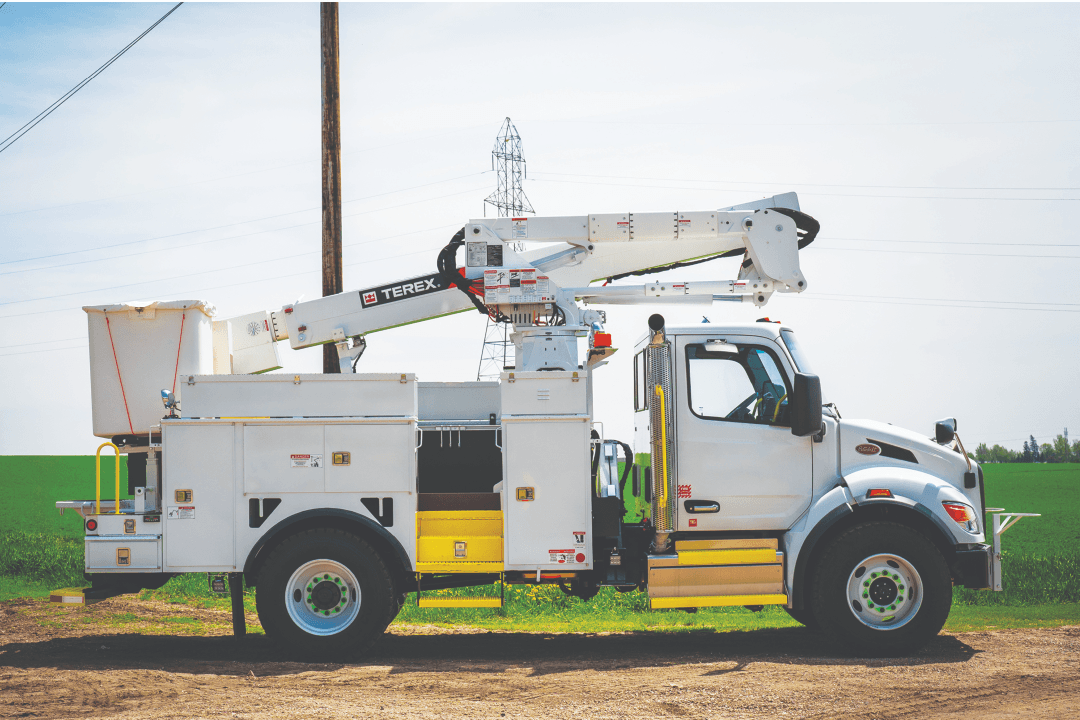
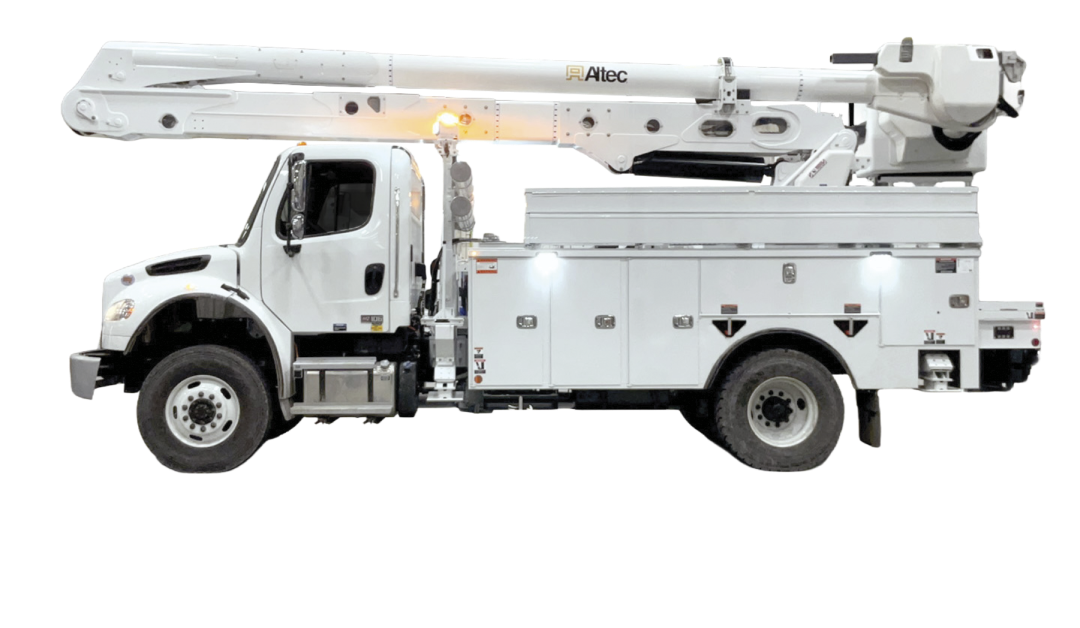
Configured to order, this Terex Utilities articulated and telescopic material handling aerial device was built for a customer in the Great Lakes region.
The conversation began with the recognition that the utility industry is entering a period of unprecedented growth. Expanding energy infrastructure, increasing demand and new technologies are placing extraordinary expectations on the equipment fleets rely on every day. As a result, long-established practices and assumptions are being revisited.
At the 2026 EUFMC, that subject was explored in depth by two representatives of leading manufacturers. Moderated by Brian Johnson, fleet manager at Alabama Power Company and an EUFMC director, the discussion featured John Bistritz, regional vice president of sales at Altec and Joe Caywood, director of commercial operations at Terex Utilities.
Together, they examined how specifications have evolved, why complexity continues to grow and how stronger collaboration can help utilities and manufacturers meet the demands of a rapidly changing industry.
Spectrum of Specifications
One of the central themes of the discussion was the extraordinary variation that exists across fleet specifications. Manufacturers continue to receive everything from simple specs to highly detailed requirements.
In some cases, specifications have been maintained and updated for decades, evolving through handwritten revisions and incremental changes. At the opposite end of the spectrum, fleets are beginning to use digital tools and artificial intelligence to analyze specifications and explore opportunities for improvement.
This broad range reflects differences in organizational size, history, resources and operating requirements. Some utilities maintain extensive engineering teams capable of creating detailed and comprehensive specifications. Others depend more heavily on manufacturer expertise and standard offerings. Between those extremes lies a wide range of approaches, each with its own strengths and challenges.
For manufacturers, the goal is not simply to build what is written in a specification, but to understand what the customer is trying to accomplish operationally and from a safety perspective. By focusing on the underlying objectives rather than individual requirements alone, manufacturers can often identify opportunities to simplify designs, reduce complexity and improve overall efficiency.
Complexity Accumulates
A recurring theme throughout the session was the way complexity gradually grows over time. Many specifications have evolved through years of additions and modifications. A safety incident may lead to a new requirement. A supply chain disruption may prompt a substitute component. A technological advancement may introduce a new feature.
Individually, each change makes sense. Collectively, however, they can produce specifications that have become layered and fragmented. Rather than periodically stepping back and reviewing requirements holistically, fleets often continue adding new elements to existing documents. The result can be a collection of requirements that does not always reflect current operational needs.
The panel participants discussed how many specification requirements were originally developed for valid reasons, but those reasons may no longer exist, and outdated requirements often remain embedded in specifications. In addition, manufacturing processes change, technology advances and new products become available.
The manufacturers went on to emphasize the value of regularly asking “Why is this still in the specification?” That question, they said, can reveal opportunities to eliminate outdated requirements, streamline equipment designs and reduce unnecessary costs.
Turning Point
The discussion highlighted the COVID-19 pandemic as a major catalyst for change. Prior to the pandemic, manufacturers were largely expected to build equipment exactly as specified. Utilities generally assumed that if a requirement appeared on a specification, manufacturers would deliver it as requested.
COVID disrupted that model. Global supply chains were impacted by shortages of parts and components, making it impossible in many cases to deliver equipment exactly as specified. Manufacturers found themselves having difficult conversations with customers about alternative solutions, substitute components and revised configurations.
But these challenges also opened the door to new forms of collaboration. Instead of focusing solely on what was written in a specification, customers and manufacturers began discussing what outcomes they were trying to achieve.
The result was a shift in mindset. Rather than asking whether a specification could be fulfilled exactly as written, organizations increasingly explored whether different solutions could accomplish the same operational objective while reducing delays and improving equipment availability.
For many fleets, this experience demonstrated that flexibility could lead to positive outcomes. By considering alternative approaches, they were often able to receive equipment faster while still meeting their operational and safety requirements.
Configured vs. Engineered Orders
Another important topic involved the distinction between configured-to-order equipment and engineered-to-order equipment.
Configured-to-order products are built from pre-engineered components and established designs. While still allowing customization, they are generally easier and faster to manufacture because the engineering work has already been completed.
Engineered-to-order products, by contrast, require additional design, engineering, sourcing and validation. Manufacturers emphasized that they remain committed to building custom equipment and recognize that custom solutions are often necessary in the utility industry. However, greater customization inevitably affects lead times, production throughput and cost.
As utilities prepare for significant infrastructure expansion, understanding these differences becomes increasingly important. Every additional customization may introduce engineering work, sourcing challenges, production complexity and support requirements that extend throughout the life of the equipment.
The message was not to avoid customization, but to understand its consequences and make intentional decisions about where customization truly adds value.
Understanding Why
Throughout the session, the panelists repeatedly returned to the importance of understanding the purpose behind a requirement. When manufacturers work directly with fleets to learn their operational and safety objectives, they can frequently recommend alternative approaches based on their experience across many customers and applications.
Manufacturers, because they work with numerous utilities, contractors and service providers, are exposed to a wide range of solutions to common challenges. A problem that seems unique to one fleet may already have been addressed successfully elsewhere. This broader perspective can help fleets avoid reinventing solutions and instead benefit from proven approaches already being used in the field.
Standardization as a Strategic Tool
Several examples illustrated how standardization can create valuable benefits. One discussion focused on the large number of variations that can exist for relatively simple components. Even small dimensional differences across similar parts can create significant manufacturing and inventory complexity. Consolidating designs around a smaller number of proven configurations can improve parts availability, simplify service support and reduce production challenges.
Another example involved the use of existing solutions that had already been developed for other customers. Rather than requiring utilities to fabricate modifications after delivery, manufacturers are often able to integrate proven designs into the original build process, putting equipment into service more quickly.
Body configurations, compartment layouts, chassis choices and paint strategies were also discussed as areas where standardization can create efficiencies. Participants noted that even modest reductions in variation can improve manufacturing performance and shorten lead times without significantly altering operational capability.
Importantly, standardization was not presented as eliminating customer choice. Instead, it was framed to focus customization where it matters most.
Changing the Conversation
The rapid pace of technological advancement is also reshaping specifications. New vehicle platforms, safety systems, collision avoidance technologies, sensors, braking systems and electronic controls all require significant engineering integration. Manufacturers must continuously adapt designs to accommodate evolving technologies while maintaining compatibility with customer requirements.
But these changes can create additional pressure to keep specifications current. Requirements that were appropriate a decade ago may no longer reflect available technology or industry best practices.
The broader message was that rigid specifications can sometimes slow the adoption of beneficial new technologies. Fleets that regularly review and refresh their requirements are better positioned to take advantage of innovations that enhance safety, productivity and performance.
Safety Through Collaboration
Because utility work involves inherently hazardous conditions, fleets seek engineering controls and equipment solutions that improve worker protection. As a result, many specification changes originate from efforts to address safety incidents or reduce risk.
However, the panel suggested that the most effective safety solutions often emerge when multiple stakeholders collaborate from the beginning. Bringing together fleet leaders, safety professionals, operations personnel and manufacturers creates opportunities to evaluate a broader range of options and identify solutions that balance safety, practicality, cost and implementation timelines.
Rather than immediately prescribing a specific solution, organizations were encouraged to define the safety challenge and engage manufacturers as partners in developing the best response. This collaborative approach can help avoid unintended consequences while leveraging industry-wide experience and expertise.
Starting Point
For fleet managers wondering how to begin modernizing specifications, the answer was straightforward: start with communication. Begin by creating opportunities to review existing specifications, engage internal stakeholders and collaborate with manufacturers.
A practical approach is to identify provisions that have not been revisited for years and examine whether they are still necessary. By systematically reviewing specifications and understanding the rationale behind each requirement, fleets can uncover
opportunities to simplify builds, improve serviceability, reduce lead times and lower costs.
There is no doubt that custom trucks will remain a critical part of utility operations, and manufacturers will continue to build them. At the same time, increasing demand, evolving technology and expanding infrastructure needs make specification modernization more important than ever.
Specification management is a strategic opportunity, the manufacturers noted. By challenging long-standing assumptions, embracing collaboration and regularly evaluating requirements, fleets and manufacturers can work together to deliver equipment that is safer, easier to support, faster to produce and better aligned with the industry’s future needs for supporting the next generation of energy infrastructure.
Oct 20, 2026
Lift & Access is part of the Catalyst Communications Network publication family.